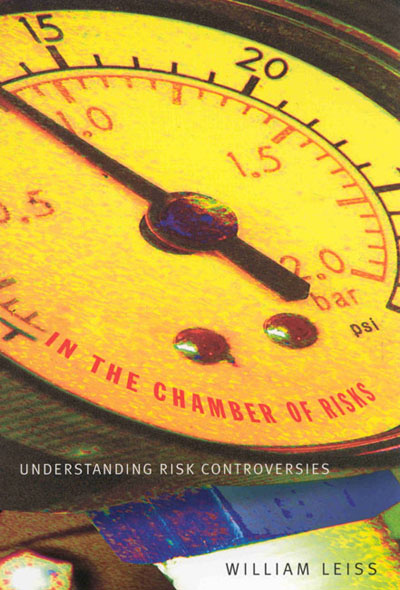
Through a new set of detailed case studies William Leiss shows that while industry and governments have made much progress in responsibly managing risks to health and environment, they generally remain quite poor at managing their involvements with risk issues, that is, with the often intense controversies about the way in which risks should be managed. This organizational risk, associated with misunderstanding the nature of risk management issues, can have damaging consequences, something that remains poorly appreciated.
The essential problem is the failure to recognize that controversies over risks are "normal events" in modern society and as such will be with us for the foreseeable future. Three key propositions define these events: risk management decisions are inherently disputable; public perceptions of risk are legitimate and should be treated as such; the public needs to be intensively involved in the processes of risk evaluation and management. Leiss and his collaborators chronicle these organizational risks in a set of detailed case studies on genetically modified foods, cellular telephones, the notorious fuel additive MMT, pulp mill effluent, nuclear power, toxic substances legislation, tobacco, and the new type of "moral risks" associated with genetics technologies such as cloning.
Contributors include Debora L. Van Nijnatten (Sir Wilfred Laurier University), Michael D. Mehta (University of Saskatchewan), Stephen Hill (University of Calgary), Éric Darier (Greenpeace), Greg Paoli (Decisionalysis Risk Consultants, Inc.), and Peter V. Hodson (Queen's University).
Details
424 Pages
ISBN 9780773522466
November 2001
Formats: Paperback, eBook
William Leiss is a Scientist, McLaughlin Centre for Population Health Risk Assessment, University of Ottawa; he is a Fellow and Past-President (1999-2001) of the Royal Society of Canada and an Officer in the Order of Canada. From 1999 to 2005 he held the NSERC/SSHRC Research Chair in Risk Communication and Public Policy in the Haskayne School of Business, University of Calgary. From 1994 to 1999 he held the Eco-Research Chair in Environmental Policy at Queen's University. Since the late 1980s he has worked extensively in a consulting capacity with industry and with Canadian federal and provincial government departments in the area of risk communication, risk management, public consultation, and multi-stakeholder consensus-building processes. He has been an advisor on issues dealing with pesticides, toxic chemicals (chlorine, dioxins, and others), tobacco, prescription drugs, electric & magnetic fields, genetic engineering, and many others. He was a member of the Senior Advisory Panel for the Walkerton Inquiry (2000-2002) and in 2000 was Chair of the Task Force on Public Participation for Canadian Blood Services.
In the Chamber of Risks
William Leiss
Table of Contents and Excerpt
Excerpt
Figures Tables Preface and Acknowledgments
Part one: Business in the labyrinth
1 Risk Issue Management
2 Frankenfoods; or, The Trouble with Science
3 Cellular Telephones
4 MMT, a Risk Management Masquerade
5 Regulating Nuclear Power: The Mismanagement of Public Consultation in Canada Michael - D.Mehta
6 Environment?s x-File: Pulp Mill Effluent Regulation in Canada
Part two: Governments in the labyrinth
7 Between Expertise and Bureaucracy: Trapped at the Interface of Science and Policy
8 The CEPA Soap Opera
9 Voluntary Instruments ?ric Darier and Debora VanNijnatten
10 Tobacco Uncontrolled
11 Into the Maze of Moral Risks
12 Towards Competence in Risk Issue Management
Appendix: Providing Independent Expert Advice to Government and the Public
Notes
References
Index
Excerpt: Risk Issue Management
The chamber of risks is a place of many rooms. The largest and best-appointed of them is the one occupied by professional risk managers, who since the 1970s have refined and codified their approach to health and environmental risks. Their current standards of practice are models of rational decision making, leading the uninitiated in step-wise fashion from the first apprehension of a concern (in technical language, the characterization of a hazard) to its resolution, which itself is usually cast in terms of how much risk is "acceptable" in a particular case. Risk managers are justifiably proud of their powerful instruments, such as toxicology and epidemiology, because risks -the chances that something seriously harmful can happen to us - are notoriously tricky, and individuals often are fooled by them. The best illustration is provided by the delay between cause and effect, known as latency: on average there is a twenty-year delay between taking up regular smoking and the diagnosis of disease, and 30 per cent of long-term users will get a serious lung ailment from smoking. One cannot learn that unpleasant truth just from a casual observation of smoking behaviour; only the analytical tools of risk assessment can sort out what is really happening to our health.
One of the great pioneers of modern epidemiology, Sir Richard Doll, first showed the association between smoking and lung cancer in 1950. Fifty years later the epidemic of tobacco use is still spreading around the world, with tens of millions sentencing themselves to an unnecessary and unpleasant form of early death. What this and much other evidence tells us is that there are other tenants besides professional risk managers in the chamber of risks. In fact risk is multidimensional, and therein lies the basis for the protracted and sometimes bitter fights that erupt regularly among the tenants there.
Many of the other occupants look at risk rather differently from professional risk managers. Many feel much more comfortable with the hazards that are familiar to them, such as car accidents on roads, as opposed to unfamiliar things, such as radiation, and they appear willing to tolerate much higher risks for the former than for the latter. Many do not react in the same way to all consequences, such as fatalities: deaths of children seem particularly troublesome, for example, as do deaths of large numbers of people simultaneously, as in airplane crashes. Not all ways of dying or falling ill are regarded as equal, with cancer or slow neurodegenerative disease being more dreaded than sudden accidental death. Many are offended if, in response to an expression of concern about a particular hazard, such as radiation from nuclear power plants, they are told that, by comparison with many other things that people cheerfully indulge in daily, it is nothing to worry about. And generally many do not understand why, with all the resources of modern science at their disposal, risk managers cannot give clear and unequivocal responses to their concerns, but instead are wont to couch their answers in terms of probabilities, that is, the chances that something bad may or may not happen.
Many simply do not trust the risk managers to tell them the truth. They have seen government and industry spokespersons change their stories on risks, fighting protracted rearguard actions against the revelation of new evidence, and also have seen them add "spin" to data so that it appears less damaging. Europeans heard British politicians loudly proclaim the safety of British beef and denounce those who would close their borders to it in the 1990s, then watched in shock as the evidence of risk slowly trickled out; as of November 2000 the entire sad litany of dissimulation about the human health consequences of "mad cow disease" seemed set to repeat itself on the European continent. The next message the public heard from some of those same government voices was that foods containing genetically modified ingredients are "perfectly safe," and many reacted with contempt. The cellular telephone industry, riding the wave of consumer enthusiasm for their handy devices, insists that "no evidence of harm" is the same thing as "evidence of safety" and keeps quiet about a recommendation in a UK expert panel report in May 2000 that children under age sixteen should use cell phones sparingly.
Professional risk managers are uneasy having to share close quarters with these other tenants. It is hard for them to understand why citizens who evidently cannot grasp the simplest scientific descriptions should want to meddle in such matters at all, rather than leaving them in the hands of capable experts. They are dismayed to hear that they are regarded by many as untrustworthy. It often offends them to be told that their findings and judgments are disputed by those who have no expertise in the relevant technical disciplines. And although these days such professionals are willing to concede that they should make determined efforts to explain to the public how they have arrived at their conclusions, as clearly and honestly as they can, many cannot accept the view that "the public" should have the final say on the acceptability of risks.
Understandable as they are, these reactions by professional risk managers are the initial steps which can, some time later, help to cause the organizations they work for - mostly industry and government departments - to stumble unwittingly into the labyrinth of risk controversy. Then the chamber of risks can turn into a chamber of horrors for business and governments.
Mismanagement of an organization's involvement in risk controversies can be very expensive indeed. An agency of the British government estimated the cost to the national treasury of the fallout from the "mad cow disease" episode, as of fall 1999, at ?10 billion and still rising. Now this human and animal tragedy is set to repeat itself on the European continent, starting in France and Spain, where governments failed to draw what should have been obvious conclusions from the UK experience, and where the final tally of economic costs will be enormous. The collapse of the East Coast cod fishery in Canada, in which mismanagement of the resource through over-fishing played a significant part, already has a multi-billion-dollar price tag for Canadian taxpayers, in order to maintain those who used to make a living in that sector, a price which will continue to rise as large numbers of people wait for the cod to return, which may or may not ever happen. A global player in the forest industry, Canada's MacMillan Bloedel (now owned by Weyerhaeuser Company), conceded that changing social values about clear-cutting and the logging of old-growth forests had significantly affected its business risk. Silicon breast implant manufacturers in North America have paid out huge sums in compensation to patients for suspected health damage that, if it occurred, almost certainly was not caused by their products. Billions of dollars was lost from Monsanto Corporation's share value on the equity markets in 1998-99, and the long-term prospects of the entire agricultural biotechnology sector were put in jeopardy by the industry's wilful failure to comprehend and accommodate public concerns in Europe. The uproar over genetically modified foods in Europe and the setbacks to that industrial sector occurred over a period of just two years, showing how quickly such controversies can strike and do damage. As corporate concentration proceeds apace with the globalization of industry, the economic stakes in risk controversies are magnified correspondingly, as is the need to discover and nurture a higher level of competence in risk issue management.
Risk is by definition a situation of uncertainty, and as a rule most of us do not handle uncertainties very well. Compounding that difficulty is the fact that the public gets so little help in understanding the basis of risk assessments from those who are keen to persuade them that there is "nothing to worry about." For example, it is very clear that many among the public do not know what genes are. So, when scientists working in the field of molecular genetics manipulate genes in the laboratory, changing the genetic makeup of everyday commodities such as corn and potatoes, and have farmers sow large quantities of the new varieties in the environment, all the while reassuring us that everything will be just fine, many respond: "Not so fast. What's going on here?" Then someone finds a genetically modified corn variety in taco shells that wasn't supposed to be there, and Kraft Foods recalls millions of dollars of products from store shelves in the United States and Canada. Aventis, the corporation which developed the corn variety, following the lead of other large multinationals, decided to get out of the agricultural business entirely after pulling its seed product off the market. At least they did not lose their shirts in the process, which is more than can be said for Monsanto.
GLOBAL CLIMATE CHANGE: A RISK CONTROVERSY IN FORMATION
Consider global climate change as a burgeoning risk issue. At stake is whether there are human-induced effects on climate, caused by the greenhouse gases (GHGs, especially CO2 and methane) that we emit into the atmosphere, which might have major - perhaps catastrophic - adverse impacts on agriculture, forests, rainfall patterns, violent storms, insect populations, disease vectors, and other domains in our lives. The stakes in this game of chance will not long permit us to take refuge in uncertainties as an excuse for either indifference or inaction, for although the relevant uncertainties are indeed huge - including whether the ultimate outcome from "global warming" may be a new Ice Age! - so too are the possible consequences. If the stakes were relatively modest, many of us might opt to wait a while before deciding whether or not to worry. But where the stakes involve some possibility of truly catastrophic dislocations in the course of civilization, are most of us prepared to have our descendants realize that we decided just to wait and see how it all came out? Actually, when the stakes start getting that high, most of us are too risk-averse for the game anyway, and we would (if we could) refuse to play. Alas, we cannot opt out of the climate change game, because GHGs are rising steadily and will continue to do so for the foreseeable future, perhaps even at an escalating pace.
Of course maybe the worst won't come to pass. Certainly we will do more science to get a better idea about what is happening to our climate, as greenhouse gas concentrations in the atmosphere continue to rise, and to be more precise about what types of actions would be required on our part if we wished to stabilize them at some level. Indeed, there is some probability that only good things will happen, because plants love carbon and we could all end up living happily ever after in a botanical paradise. There is also some probability that nothing very bad will happen, as GHG concentrations rise, because offsetting changes in the atmosphere will occur naturally, and everything will stay just about the way it is now. And there are the other, darker possibilities, namely, the advent of catastrophic dislocations in our established ways of life from human-induced climate change. The awkward problem - if we wait, first, for "convincing scientific proof" one way or the other that climate change is or is not significantly related to anthropogenic GHG emissions, and, second, to see whether the net results look all right or alternatively quite bleak to us - is that it may be too late to do anything at all about a bleak prospect. We may not be able to reverse the course of events, despite our technological prowess, should the natural systems thus set in motion turn out to be resistant to further influence from us.
Thus no matter how any of us calculates the risks associated with climate change itself, or the risks associated with our responses to this issue, what none of us can avoid is a confrontation with the unpleasant business of decision-making under uncertainty, where the stakes - including the economic costs and benefits - are enormous. Nations such as Canada have to manage disagreements among their own citizens, over whether to take actions or not (actions that impose real costs to us), and if so, what ones we should take if we wish to be "precautionary" in the face of these risks. Nations will have to participate in international disagreements over who is responsible for what part of this problem, and who should pay to fix it, and whether developing countries should pay anything at all. There will be monumental fights over what actions by various countries will "count" in the way of garnering credits for sequestering carbon: for example, many find rather upsetting Canada's claim that it could be entitled to emissions credits for selling its nuclear power plants abroad, on the grounds that using nuclear power to generate electricity displaces the GHG s otherwise created by using fossil-fuel energy sources. In the meantime everyone is hoping that science will come up with definitive conclusions one way or another, so that all can agree on what we must do, however expensive it proves to be - an expectation that is, unless I miss my guess, certain to be frustrated for a long time to come.
At the time of writing, national governments had left The Hague after the latest (failed) round of negotiations under the Kyoto Protocol, including countries such as Canada, which agreed in 1997 to reduce its GHGs and has watched its emissions rise steadily thereafter, having done almost nothing to honour that commitment. The fossil-fuel industries, including the great multinationals which dominate the petroleum business, are manoeuvring carefully to avoid being tagged with too great a share of responsibility for picking up the slack. But there is trouble brewing in the future for both governments and a variety of industry sectors.
The reason is simple. Most governments in the developed world have told their citizens that they are committed to "taking action" on the climate change issue and that they support the objectives of the Kyoto Protocol, even though few meaningful actions have been taken just yet. But what these governments have failed to tell their citizens is that, if present or anticipated future GHG concentrations in the earth's atmosphere are a problem worth worrying about, the Kyoto Protocol will not solve that problem ? because the agreed-upon reductions are so trivial. The reductions in GHGs for the developed economies agreed upon at Kyoto (in the range of 5 per cent to 7 per cent below 1990 national emissions levels) would, if fully implemented, just delay the doubling of GHG concentrations in the atmosphere, relative to pre-industrial times, by about one decade.
I suspect that many citizens have been led to believe that implementing the Kyoto Protocol, by stopping further increases in GHG emissions in industrialized countries, will therefore "solve the problem" in the sense that global GHG concentrations will stop rising, which is most certainly not the case. The reason is straightforward: "Because of the long atmospheric lifetimes of most greenhouse gases, concentrations will continue to rise for a long time even after emissions stabilize or drop." Global CO2 emissions are currently about nine gigatonnes per year (GTC/yr) and in some scenarios will peak at about sixteen GTC/yr around the middle of the twenty-first century before starting a long decline; at that point atmospheric CO2 concentrations are forecast to be above 750ppm, about double the current levels. To achieve an objective such as "stabilizing" global GHG concentrations at some specified level, say 500ppm - which is about 125ppm higher than present levels - would require enormous reductions in current emissions, of the order of 60 per cent or more below current levels. Attempting to meet any such objective would substantially reduce our present standard of living, which is why no politician wants to breathe a word about these scenarios. When the public awakens to these unpleasant truths, the "issue" of global climate change will be considerably hotter than it is now, and there will be much anguished finger-pointing among governments and industry players as blame is assigned for misleading the public.
Whatever the ultimate outcome, the climate change conundrum will demand that all players do much better at risk issue management in the future than they have in the past. And since climate change exhibits in exaggerated form the characteristics of risk issues generally, the baptism of fire we are about to undergo in dealing with it should be beneficial to us in more ways than one.
FROM RISK MANAGEMENT TO RISK I S SUE MANAGEMENT
There are long-standing deficiencies in the organizational structures and personnel complements among institutions charged with health and environmental risk management. These deficiencies stem from a failure to understand the essential difference between risk management and risk issue management. I will introduce this terminology here and return to it in the concluding chapter.
Risk management for health and environmental risks uses scientific risk assessments to estimate the probable harm to persons and environments resulting from specific types of substances or activities. As such, even when risk managers seek honestly to take into account varying perceptions of the risk in question among different sectors of the public, they are necessarily and properly constrained by the scope and limitations of their scientific assessment in recommending specific courses of action. This is an inescapable part of their duty to protect public health to the best of their ability, taking into account the uncertainties that are always a factor in risk estimates. Mistakes can and will be made in this regard for a whole host of reasons; the public only has a right to expect that the risk management protocols will be sufficiently self-critical and iterative so that serious mistakes are discovered and corrected in the shortest possible time-frame.
Risk issue management is fundamentally different from risk management. The most important difference is that risk issues, as they play out in society at large, are not primarily driven by the state of scientific risk assessments. Rather, such assessments are just one of a series of "contested" domains within the issue. The phrase "risk issue" refers to any of the following types of risk management situations, for example:
Stakeholder confrontation, or the existence of some dispute - about the scope or existence of a risk and how it should be managed - among interested parties, e.g., between environmental non-governmental organizations (ENGOs) and government or industry (such as in the cases of dioxins or genetically modified food crops);
Intractable behaviour, or the persistent inability of professionals to change the public's risk-taking behaviour to some desired degree (cases of drinking/driving by young males or tobacco use);
High uncertainty, or the public expressions of concern over risk factors that are poorly characterized from a scientific standpoint, or where uncertainties in risk assessments are quite large, despite the fact that technologies giving rise to them are already in use or in active development (cases of cellular telephones, cloning, GHG emissions and climate change).
Both public-sector risk management agencies and industries get caught up in such issues daily. Indeed, for professional risk managers this is becoming the stuff of everyday life: a good deal of ongoing scientific review is mixed with some low-level issue management, but the organization never seems to know when or under what circumstances something is going to erupt into a high-profile controversy. This is because it is not aligned or staffed explicitly to deal with risk issue management.
Risk issues are configured by the competing attempts of various stakeholder interests to define or control the course of social action with respect to health and environmental hazards. Issue management refers to the relation between an organization and its larger social "environment," where reigning public policy provides the basic "rules of the game"; and it is inherently governed by strategic considerations as developed by an organization or even a loose collection of individuals. All those who wish to become skilled interveners in risk controversies, such as ENGOs, as well as those who will inevitably be caught up in them, namely industry and governments, become issue managers (by choice or default). To do so entails understanding the internal dynamics of risk controversies and seeking to influence them towards some final resolution; in most cases this will be called the "public interest," although inevitably there will be diverse definitions of what this means in practice. These resolutions may be, for example, introducing a new substance or activity or banning an existing one; changing laws or the regulatory environment; adopting new principles, such as the precautionary approach; introducing changes in business practices; approving a new economic development project or creating wilderness preservation zones; and so forth.
To put the main point a bit differently: Whereas risk management seeks to assess and control a risk domain, risk issue management responds to a risk controversy. A risk domain is an activity, technology, or environmental hazard that has a unique collection of risk factors associated with it; for example, smoking is a risk factor for cancers of different organs, arteriosclerosis, stroke, emphysema, and many other diseases. The risk factors in various risk domains, as assessed or perceived by various parties over time, quantitatively and qualitatively, become the subject of risk management decision making, which may lead to risk reduction strategies or other actions.
A risk controversy, on the other hand, is a risk domain which becomes the subject of a protracted battle among stakeholder interest groups, the outcome of which may or may not be consistent with any set of decision options preferred by the risk managers (in government or industry) who have "official" responsibility for the file in question. The evolution of a risk controversy is determined primarily by the competing strategies of whatever groups or organizations choose to, or are compelled to, enter into it; as mentioned earlier, the objective of these strategies is to steer the outcome of the controversy towards some preferred risk management option.
Since by definition a risk controversy is an area of competing visions about where an optimal resolution lies, competence in risk issue management should not be understood as seeking to "control" the outcome. Rather, it means in general being able to compete successfully with other influential stakeholders within the zone of controversy, in a way that is appropriate to the specific positioning of an organization and its lines of accountability within society as a whole. Industry, ENGOs, and governments all have quite diverse positionings in this regard. Governments' positioning is defined primarily by their role in defining and defending "the public interest" as such - for example, seeking to be as "inclusive" as possible in relation to the spectrum of social interests. Business and industry traditionally are regarded as having the promotion of shareholder interests as their leading, if not sole, aim; however, this view is changing (as is the law of corporate governance), as major corporations wish to acknowledge both environmental and social responsibilities in their areas of operation. Environmental and other non-governmental organizations would appear to be answerable solely to their supporters and funders, although there are efforts under way to hold them accountable for their actions and arguments before some kind of wider public tribunal.
Within the zone of risk controversy, risk assessment and management are strictly subordinate activities, the outcome being determined primarily by which of the participant organizations develop the most successful strategic manoeuvres. Sometimes the scientific assessment is definitive for the issue resolution and sometimes it is not; the outcome is often impossible to predict, and in any case depends primarily on the specific pathway along which the issue evolves. In some notorious cases (such as Alar and apples or saccharin, for example), most observers remain convinced, years or decades after the key events, that from the standpoint of "good science" the wrong resolution occurred. In others, such as BSE and British beef, or health risks associated with radiofrequency fields, the weight of massive and irresolvable uncertainties about the scope of exposure and potential harm hangs like a dark cloud over both the issue and its resolution to date. Even where a broad stakeholder consensus based on scientific evaluation finally emerges, as it has now with a group of chemicals called "persistent organic pollutants," that consensus is the product of a long and tortuous pathway filled with recriminations directed at some parties by others. In all such cases scientific assessment played or plays some role in the issue evolution, but only as one factor among many.
The divide between risk management and risk issue management affects none more seriously than governments. They must do both. Over the past thirty years, coincident with the rise of the modern specialized field of health and environmental risk management, many governments, including Canada's, as well as industry sectors, have developed outstanding expertise in risk assessment and management. But none of them is much good at risk issue management, for a number of reasons, but mainly because they do not accept the legitimacy of risk controversies. I shall return to this theme in the concluding chapter.
Involvement in risk controversies poses distinctive problems and challenges for the organizations which either choose to become engaged with those issues (ENGOs, citizen groups) or are compelled by legal or other mandates to do so (business, governments). On a pragmatic level, the problems include training and supporting competent personnel; allotting adequate resources; understanding the nature of the issues at all organizational levels; maintaining involvement over long periods of time; and relating fairly and effectively to other stakeholders. The challenges are quite severe; they include reacting responsibly to highly emotional situations, handling large uncertainties in decision-making frameworks, and taking into account the often very different values and perspectives that various stakeholders bring to risk issues.
There is very little in the health and environmental risk management literature explicitly dealing with managerial factors as such. A variable called "perceived managerial (in)competence" has been identified, however; it is defined as the "degree to which the public believes that a hazard implies that similar risks are being managed incompetently." The key finding is stated as follows: "Perceptions of managerial incompetence influence the public's response to a hazard to a degree approaching the scale of the event." Here is a finding, derived from the well-known concept of "risk amplification," that is of direct relevance to the mission of risk managers. It means that managers have a lever with which they may be able to influence the outcomes of controversies over risks in society, helping to produce better resolutions to those controversies ? so long as they are in a position to operate the lever.
Thus "managerial competence" is a domain where improvement in risk issue management is or ought to be possible, at least in theory. I believe that one primary source of the countervailing perception (to wit, that widespread managerial incompetence prevails) is to be found in a faulty self-assessment and self-representation, by the agencies charged with health and environmental risk management, of their basic mission. To put the point succinctly, they have conceived themselves (over a long period of time) as experts in hazard characterization, and to a lesser extent in risk assessment, whereas what is needed from them above all is expertise in risk issue management. Those agencies naturally also configured their professional staff complement in line with this conception. The commonest example of these faults can be found in the responses of such agencies over the years to public expressions of concern about hazards that fall under their mandates: all too often the representatives of those agencies addressed the hazard characterization (and did so quite fairly, on the whole), but not the concern. What is needed above all is competence in addressing the unity of hazard-plus-concern.
The chapters to follow will illustrate and explain, through case studies and analysis, both the meaning and the importance of the distinction between risk management and risk issue management. In part 1 the studies concentrate on the ways in which industry and business can get trapped in the labyrinth of risk controversy, while part 2 gives a complementary picture where governments are involved. In both sets of cases, however, the other often appears, because governments and business interact so closely in matters of risk management. Indeed because of the close interaction of business and government in today's economy, there are ample opportunities for each to do considerable damage to the other through failures in risk issue management. The chapters to follow illustrate this well. In the cases of genetically modified foods, cell phones, MMT (a manganese-based fuel additive), and nuclear power, serious failings by industry in risk issue management have compromised government's ability to carry out publicly credible risk management. On the other hand, the case studies of pulp mill effluent, toxic chemicals management, tobacco control, and cloning risks show that governments are sometimes paralysed by risk issues and unable to give clear policy direction either to the public or to industry (or in some cases both). Although there is only a brief mention of the issue of global climate change in chapter 1, this risk controversy in formation already shows how some governments are willing to leave industry twisting in the wind, as the controversy mounts, by avoiding their responsibilities to set a clear policy context and to help the public understand the full ramifications of this complex issue.
As well, in many of these cases environmental and citizen groups appear as important players, and their importance is likely to increase in the coming years. The evolution of issues such as genetically modified foods, toxic chemicals management, and climate change have been dictated in part by ENGOs that have shown themselves capable of matching industry's global reach, while in others (such as nuclear power and cell phones) more localized citizen groups have been significant actors in the controversies.
9780228017240
$130.00 CAD
Cloth
9780228009160
$24.95 CAD
Cloth
9780773535671
$22.95 CAD
Paperback
9780773516199
$37.95 CAD
Paperback
9780773511774
$125.00 CAD
Cloth
9780773507487
$40.95 CAD
Paperback
9780773506886
$37.95 CAD
Paperback
Finalist
Raymond Klibansky Prize (Humanities)
Federation for the Humanities and Social Sciences (2003)
 Login
Login Create Account