Perhaps we should rejoice in the disappearance of Canada. We leave the narrow provincialism and our backwoods culture; we enter the excitement of the United States where all great things are being done. Who would compare the science, the art, the politics, the entertainment of our petty world to the overflowing achievements of New York, Chicago, San Francisco?
George Grant, Lament for a Nation
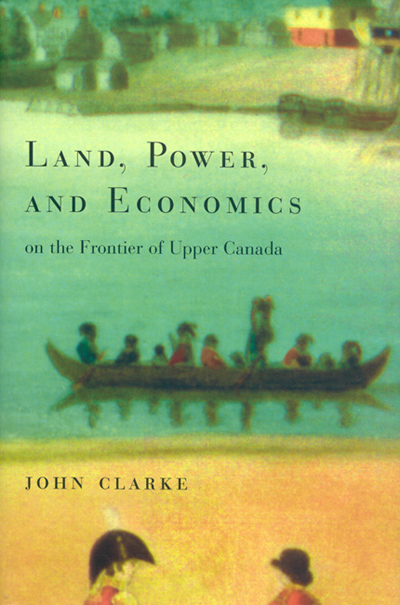
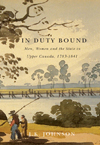
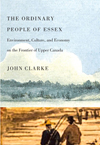
In this thorough study of an important period, Upper Canadian attitudes to land and society are shown to have been built on contemporary visions of the cosmos. John Clarke examines the actions of individuals from the perspective of the political culture and its manifestations, doing so within the constraints of geography and the cultural baggage of the settlers. Placing human action in the context of economics and laissez-faire capitalism, Clarke shows how almost unbridled acquisitiveness, and its concomitant land speculation, could promote or hinder development.
The prevailing ideology in Ontario at the time was a conservative culture that rejected everything American and attempted to preserve the best of the British world in the new Eden. Those building the state believed that a social and political hierarchy composed of those possessing a "natural virtue" would serve society best. In consequence, a few individuals at the top of the hierarchy, through their access to power, came to control the bulk of the land, the basis of the economy. At the other end of the spectrum from the elite were those transforming the land and themselves through their own labour. How did the physical environment and government land policy affect the pattern of settlement and the choice of land for a viable farm? What was the price of land, and how common was credit? Did the presence of reserved lands hinder or promote development? How extensive was land speculation and how did it operate? Clark brings these issues and more to the forefront, integrating concepts and substantive issues through a problem-oriented approach. Blending qualitative and quantitative approaches, he weaves together surveyors' records, personal and government correspondence, assessment rolls, and land records to measure the pulse of this pre-industrial society.
Review quotes
"Clarke's holistic approach in terms of comprehensive recording of land dealings for the sixty-five-year period, as well as his biographical and chronological evidence, represent a new methodology. His theoretical focus on the career acquisitiveness of the elite, coupled with the detailed land transactions for the county as a whole, is unmatched in thoroughness." Alan G. Brunger, Department of Geography, Trent University
"A significant contribution to the field of historical geography. This is a synthetic study that brings together interrelated questions on land, economy, society, and power. While these themes have been addressed in many works, few have attempted to bring them together in the context of early Ontario and investigate their relationships at such a detailed level. The great strength of this book is that it synthesizes the important work the author has carried out during the course of his career in a manner that is more integrative than encyclopaedic." Randy Widdis, author of With Scarcely a Ripple: Anglo-Canadian Migration into the United States and Western Canada, 1880-1920

John Clarke is professor of geography and environmental studies at Carleton University.